
Less Complexity. Better Performance. One System That Does Both.
The Bio Fiber wall assembly was built for the realities of professional construction; tighter energy codes, thinner margins, and clients who expect buildings that perform for decades, not just at inspection.
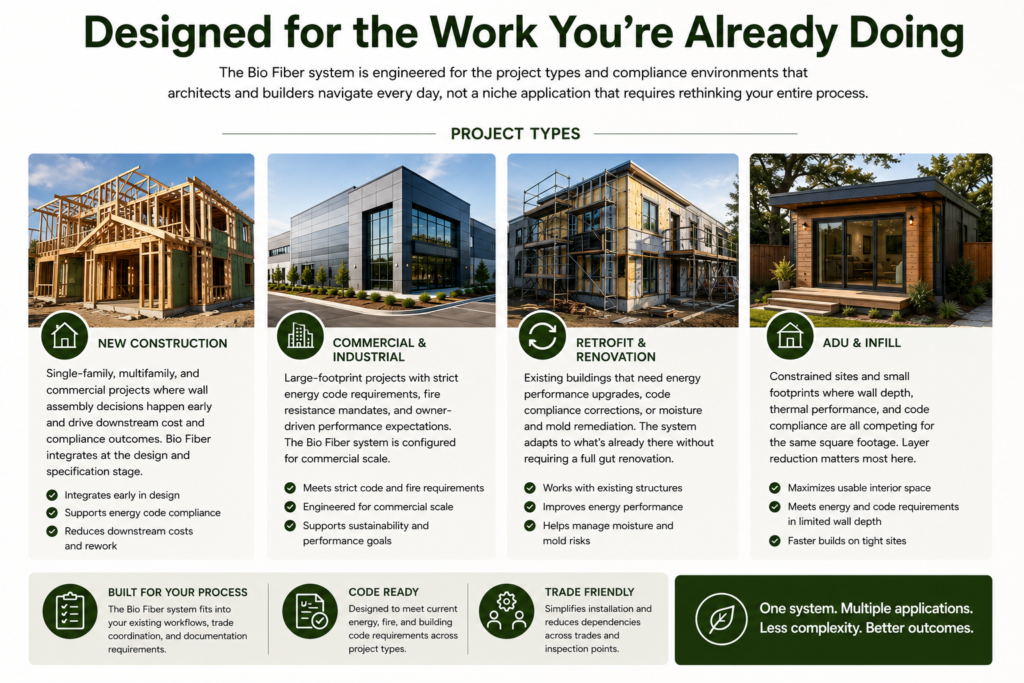

Designed for the Work You’re Already Doing
The Bio Fiber system is engineered for the project types and compliance environments that architects and builders navigate every day, not a niche application that requires rethinking your entire process.
Project Types
New Construction
Single-family, multifamily, and commercial projects where wall assembly decisions happen early and drive downstream cost and compliance outcomes. Bio Fiber integrates at the design and specification stage.
Commercial & Industrial
Large-footprint projects with strict energy code requirements, fire resistance mandates, and owner-driven performance expectations. The Bio Fiber system is configured for commercial scale.
Retrofit & Renovation
Existing buildings that need energy performance upgrades, code compliance corrections, or moisture and mold remediation. The system adapts to what’s already there without requiring a full gut renovation.
ADU & Infill
Constrained sites and small footprints where wall depth, thermal performance, and code compliance are all competing for the same square footage. Layer reduction matters most here.
Who This Is Built For
- Architects specifying wall assemblies for energy code compliance
- General contractors managing multi-trade wall system installation
- Design-build firms controlling both specification and execution
- Developers evaluating long-term performance and lifecycle cost

One Integrated Assembly. Fewer Layers. Faster Installation.
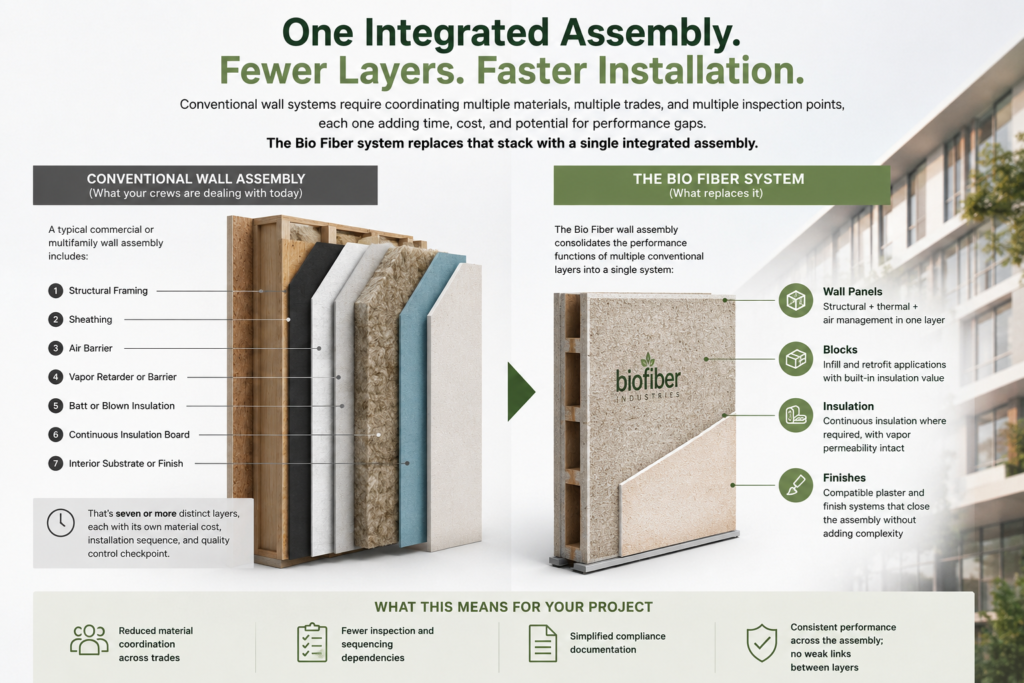
Conventional wall systems require coordinating multiple materials, multiple trades, and multiple inspection points, each one adding time, cost, and potential for performance gaps. The Bio Fiber system replaces that stack with a single integrated assembly.
Conventional Wall Assembly (What your crews are dealing with today)
A typical commercial or multifamily wall assembly includes:
- Structural framing
- Sheathing
- Air barrier
- Vapor retarder or barrier
- Batt or blown insulation
- Continuous insulation board
- Interior substrate or finish
That’s seven or more distinct layers, each with its own material cost, installation sequence, and quality control checkpoint.
The Bio Fiber System (What replaces it)
The Bio Fiber wall assembly consolidates the performance functions of multiple conventional layers into a single system:
- Wall Panels: Structural + thermal + air management in one layer
- Blocks: Infill and retrofit applications with built-in insulation value
- Insulation: Continuous insulation where required, with vapor permeability intact
- Finishes: Compatible plaster and finish systems that close the assembly without adding complexity
What This Means for Your Project
- Reduced material coordination across trades
- Fewer inspection and sequencing dependencies
- Simplified compliance documentation
- Consistent performance across the assembly; no weak links between layers
Everything You Need to Specify and Build
Whether you’re evaluating fit, writing specs, or prepping for installation, the documentation is ready when you are.
Construction System Overview:
A complete introduction to the Bio Fiber wall assembly system: components, applications, and performance summary.
Installation Overview:
A step-by-step guide to Bio Fiber system installation: sequencing, trade coordination, and quality checkpoints.
System Spec Sheet:
Detailed technical specifications for wall panel, block, and insulation components, formatted for project documentation.
Project Readiness Checklist:
A one-page tool to help you assess whether your project is a strong fit for the Bio Fiber system before starting the intake process.
Built to Install Without Reinventing Your Process
The Bio Fiber system is designed to integrate with the construction methods and trade sequences your crews already use. No proprietary tools. No full retraining. No single-source dependency that stalls your schedule.
How Installation Works
Step 1: Pre-Construction Review
Before breaking ground, our team reviews your project drawings and confirms system configuration, component sizing, and sequencing recommendations. This step eliminates the most common installation variables upfront.
Step 2: Component Delivery
Bio Fiber system components are delivered to your site per project schedule: panels, blocks, insulation, and finish materials staged for your sequence.
Step 3: Assembly Installation
Wall panels and blocks are installed using standard construction methods. Our installation guide provides trade-specific sequencing, fastening specifications, and quality checkpoints at each stage.
Step 4: Finish Integration
Compatible plaster and finish systems close the assembly. Detailed guidance on finish application is included in the installation documentation.
Step 5: Documentation & Closeout
Bio Fiber provides the project documentation you need for compliance sign-off, including performance data, system specs, and installation confirmation..
Is Your Project Ready for Bio Fiber?
Use this checklist to quickly assess whether your current project is a strong candidate for the Bio Fiber system. If you can check most of these boxes, you’re ready to start the conversation.
Project Scope
- [ ] New construction, retrofit, or renovation involving exterior wall assemblies
- [ ] Project requires compliance with current energy codes (IECC, Title 24, or equivalent)
- [ ] Building type is residential, multifamily, commercial, or industrial
Design & Specification Stage
- [ ] Wall assembly has not yet been fully specified, or is open to value engineering
- [ ] Architect or designer is available to review system integration
- [ ] Project drawings or schematics are available for technical review
Performance Requirements
- [ ] Project requires fire-resistant wall assembly
- [ ] Moisture management or vapor control is a design consideration
- [ ] Long-term building performance or sustainability goals are part of the owner brief
Project Timeline
- [ ] Construction start is 60 days or more out (recommended for full system specification)
- [ ] Retrofit or renovation timeline allows for wall assembly coordination
Let’s Talk About Your Project.
Whether you’re in early design or ready to specify, we’ll meet you where you are. Submit your project details and we’ll respond with fit assessment, relevant specs, and recommended next steps.